Monday, August 28, 2006

A weekend that was

Unlike any other weekends, last weekend was one that I didn't opt to go home. Not that I didn't want to go home (and I actually did, but just for a few hours to take some things), but I was involved as a performer for the Convofair and Convocation Lunch ceremony.

My performance together with the UTP Chinese Orchestra was on last Saturday at the ConvoSquare, where the Convofair was held. Convofair is just like a normal fair or expo whereby companies are invited to set up booths to promote their items or to give information to the people. It's just that during the Convofair, there would also be big-scale performances (dances, singing, orchestral performance, etc.) and lots of food to eat!

The Convofair is a big function because it is when the Convocation is held, too. The Convocation is normally known as the Graduation Day for undergraduates and foundation students who have graduated their courses. During the Convocation, the Chancellor of UTP, Tun Dr. Mahathir Mohamad will be here for the ceremony.

I had enjoyed myself thoroughly during the Convofair. One particular booth sold digital cameras and it so happened that I am in dire need of one (conventional cameras don't allow me to take as many pictures as I want), so I went to have a look at the cameras that they had promoted. Among the brands they promoted were Canon, BenQ, Samsung (one model) and Panasonic (one model).

The prices of most of the cameras were within my budget (of RM500 to RM700). With RM499, I could buy a Canon A430 4.0 megapixels camera with a 512MB memory card already! To me, it is rather a good deal but something struck me: a BenQ camera, 6.0 megapixels (TFT screen) with a 1GB memory card plus rechargeable batteries at RM599.

For a while, I couldn't decide on which camera I should buy, because both the Canon and BenQ cameras were quite appealing to me. It is true that BenQ is a better deal, but Canon has a better support service. I had tried BenQ cameras before and more often than not, they give me more headaches than solutions.

As I was undecided, I telephoned three "experts" (one of them is a teacher, the rest are my peers) in choosing a digital camera. Out of the three, all of them told me that Canon was a better buy although it has a lower resolution (a 4.0-megapixel camera could give a clear 8R print already) because Canon is a more well-established company compared to BenQ and its (Canon) support (including online support) is simply first class. One even said that although BenQ camera might be a 6.0-megapixel one, she doubts whether it really is a 6.0-megapixel camera. She had experience before with a BenQ camera which said that its resolution is higher than her Canon camera, but the print-out of the picture from her Canon camera (lower resolution) turned out to be clearer, sharper and better than the print-out of the same picture but from the BenQ camera.

Having decided to have the Canon camera, I went to the bank to withdraw money from the ATM. I was wondering why were there people waiting near the bank and there were road blocks. Ignoring the small crowd (I noticed that some were the authorities of UTP), I made my way to the Auto-Teller Machine and withdrew some money. I was about to leave after withdrawing my money when I turned and, lo and behold, I met Tun Dr. Mahathir face to face! For a moment I thought, "I should have taken my camera out so that I could have a picture with him!" There were not many people around him so taking a picture with him shouldn't be a problem. I smiled at him and he returned my smile. We exchanged not a word, for I was too stunned to say anything (he appeared so suddenly) and it wasn't so necessary for him to offer any word at all. Nevertheless, our smiles conveyed the message: "Hello."

I made my way to the Convofair again to purchase my camera. With the camera bought, I can now take pictures easily, upload them into my computer and use them for my blog!

On Saturday night, the UTP Chinese Orchestra was required to perform. Before we performed, we enjoyed an array of dances by students from various countries including: South Africa, Mozambique, Cambodia (it reminded me of the Ngajat dance), Thailand, Pakistan, Malaysia (they did the Punjabi dance; nicely done!) etc. Then, it was our turn to perform. Our performance received some good response, if not excellent.

Yesterday, the UTP Chinese Orchestra was required to play during the Convocation Lunch too. It was when I got to meet Tun Dr. Mahathir again. The lunch was after the Convocation ceremony. The UTP Chinese Orchestra was not the only group performing. There were also the UTP Orchestra Indian Musical group and the Malay Caklempong group. All of us performed well and at the end of the performance we even combined forces to play Rasa Sayang, which received much applause from the VIPs and the lecturers who were there during the lunch.

During the performance, all the male performers were required to wear a certain type of outfit that Tun Dr. Mahathir used to wear (even until now). When I got the outfit, it somehow reminded me of the kind of outfit Dr. Sun Yat-Sen and Mao Zedong used to wear, too. When I get the pictures uploaded, I'll post the pictures here to let you see.

With the Convofair over, it is time for me to get back to my original life in university. Tutorials and assignments still pour in, as usual, and I feel more settled and contented to do my work now.

Labels:

Friday, August 25, 2006

UTP Sixth Convocation Ceremony 2006

Should I be overjoyed about the sixth UTP Convocation Ceremony? After all, I'm not graduating my Foundation studies yet, nor am I a distinguished guest of the Convocation (also known as Convofair). However, I am rather happy that I am part of the performance group who will be performing during the Convofair in the presence of the former prime minister of Malaysia, Tun Dr. Mahathir Mohamad, the Chancellor of UTP.

It isn't that I am happy to be able to meet Tun Dr. Mahathir. It is also that I am able to make use of the knowledge that I learnt since Form 1 in the Michaelian Chinese Orchestra. UTP now has its own Chinese Orchestra and I am proud to be able to join their team and be able to help develop the group.

For the past few weeks, we have been practising for the Convofair. Normally, we would begin at around 8.00 p.m. and finish at around 10.00 p.m. But as Convofair draws nearer, the pressure is felt and practice hours become much longer. Today, believe it or not, I was at the Multi-Purpose Hall for seven hours starting from 5.00 p.m. to 12.00 midnight, practising.

Yeah, I know that many would say I've been wasting too much time. Seven hours! I could do a lot fo revision and have discussions or even do some light reading. However, thankfully, this is the first and final time that we will have a seven-hour practice. There will only be four hours of practice tomorrow and no more, because the Convofair begins on Saturday and ends officially on Sunday. Next week onwards, I shall be only occupied with assignments, as usual.

In an unrelated matter, I have been elected as the Head for the IT or Media Department (I'm not sure which section yet) for a Drama competition that will be held on the 1st of November and 8th of November this year. During the last semester, my English lecturer wanted to have the Drama competition but it didn't work out. This semester, she is determined to make it a success and therefore has purposely picked me to head one of the departments; I have experience in drama, remember (why must this sentence remind me of someone in school, whom I'd mentioned before in my Annual School Drama post, who still doesn't portray a good impression to me?)?

Well, looks like this semester will be a busy one for me. I see no time for me at all. I'd better make use of the time now to go and have my sleep!

Labels:

Wednesday, August 23, 2006

14 Hours of Non-stop Action

It was supposedly the most hectic day of my week. And the fact that my Introduction to Computer and Information Systems lecture at 8.00 a.m. was cancelled didn't make my day any better, too. That particular day was yesterday, Tuesday the 22nd of August 2006.

I was rather happy to receive the announcement that the ICIS lecture was cancelled. That meant that I would have more time to rest (mark: sleep) and also more time for me to prepare for my Chemistry lab which was at 10.00 a.m. However, to my horror, I found that I had hardly any time at all to even stop for lunch.

If you're wondering what my Tuesday timetable is like, here it is:

8.00 a.m. to 9.00 a.m. - ICIS lecture
10.00 a.m. to 12.00 noon - Chemistry Tutorial/Lab
1.00 p.m. to 2.00 p.m. - English lecture
2.00 p.m. to 3.00 p.m. - Physics lecture
4.00 p.m. to 5.00 p.m. - Engineering Mathematics lecture
5.00 p.m. to 7.00 p.m. - English Tutorial

Based on the above timetable, you can see that I have only enough time for lunch at 12.00 noon and a bit of nap at 3.00 p.m. However, yesterday, I hardly had fifteen minutes for lunch and no time for nap at all.

I had to do three graphs for my Chemistry lab work. After doing the experiment, I was supposed to submit the report at 4.30 p.m. on the same day. I was like, "Now, how am I going to complete my work? No way will I be able to complete the three graphs and answer the remaining questions if I start my work at 3.00 p.m.!" So, I decided to have lunch and at 1.00 p.m. I went, dutifully, for my English lecture.

But when the lecturer started her lecture, I had no other option but to take out my Chemistry work and start completing it. There was no use being guilty about it because soon, I felt thankful about completing them during other lecturers' lectures; otherwise, I would not be able to finish my work at all! And I would have been penalised if I had submitted my report late.

The graphs took me two hours to complete, which meant that I took the whole of English and Physics lectures to do my graphs. And at 3.00 p.m. I rushed back to my room to complete the remaining questions at the Discussion section.

At 3.30 p.m. upon completing my report, Josiah and I rushed to Building 19 to submit our lab reports, only to find that we were the first ones to submit the report. Good! we thought. And thus, feeling much relieved, we made our way for our Engineering Mathematics lecture in Lecture Hall 1, 10 minutes away from Building 19.

By the time I returned to my room at around 7.00 p.m. I felt really tired because I had not rest at all since 10.00 a.m. and yet I'd got other things to do. I knew that UTP Chinese Orchestra was going to have practices, so I took a quick bath (of course making sure that I'm clean) before rushing off to Multi-Purpose Hall to have my dinner there (dinner is provided for those involved in the Convofair). Then, at 8.00 p.m. our practices started. As the instructor was not there to conduct, so I was asked to conduct the orchestra. The practices ended at around 9.30 p.m.

I walked back to my room, went online for a while to check the day's news, downloaded Kei Fai's questions about his assignments and tried to attempt the questions before Jared came up to my room and reminded me about Cell Group. It was about 10.30 p.m. Fine, I thought, I'd go for the Cell Group meeting.

The meeting lasted for almost one and a half hours, and by the time the meeting finished, my friends in the Cell Group would say how haggard I looked, and I had to account for my tired looks. When I reached my room, Jared told me how terrible I looked. Therefore, I concluded that I had to lie down and sleep. I meant to blog after the Cell Group meeting, but no, my energy had been totally drained. I changed into my pyjamas and immediately slept, only to wake up at 10.00 a.m. the following morning. As ICIS lecture at 10.00 a.m. today was also cancelled, waking up at 10.00 a.m. was totally OK. I felt much refreshed.

Fortunately, my day yesterday started at 10.00 a.m. However, I wouldn't be so sure about my future Tuesdays, for I have ICIS lecture on that day. If my Chemistry lab requires so much work, I'm afraid I'd collapse in my bed easily that night.

Labels:

Tuesday, August 22, 2006

Sweet Sunday

I wanted to put up this post yesterday itself, but due to time constraints and being occupied by work, I had to wait until now to write about what happened on Sunday the 20th of August, 2006.

That morning, my parents decided to go to Yuk Choy Primary School for breakfast as there was a Hainanese Cuisine Fair there, organised by the Perak Hainan Association. We had a nice time there, trying all sorts of Hainanese dishes that I have not seen before either.

This fair was unlike any other fairs. It was a great occasion which was officiated by the Deputy Minister of Higher Education, Dato' Ong Tee Keat. Yes, he had come himself to the school to officiate the ceremony and even delivered his speech. His speech made my parents very interested.

His speech highlighted about the current racial issues that the country is facing. He reminded us the need for racial integration and talked on how to resolve problems that may involve racism. He even highlighted certain sensitive issues which I am not compelled to write here.

That Sunday wasn't any ordinary Sunday for me. It wasn't any other weekend either. After watching The Hunchback of Notre Dame, I felt compelled to stay at home and be quiet for a while. However, I just couldn't bear to sit still with the mood to go out with friends, especially with those who could hardly come back for any reunion. Therefore, at around 11.45 a.m. I decided to phone Kei Fai and asked him out for lunch, if he wanted. I also asked if Jun-Xiang was with him, and he said yes. However, they already had lunch at the Stadium and they wanted to go to Inferno for a game of DotA. Here is the phone conversation I had with Kei Fai:

Kei Fai: Hey, Guo Zheng! Let's go to Inferno. It's just behind Jusco. Jun-Xiang and Yoke Teng are coming too!

Yours truly: (after a thought) Hmmm... OK, I'll meet you people at Inferno then. Give me fifteen minutes, yeah? What are we going to do there?

Kei Fai: Let's play DotA.

My dearest readers, please take note that I have only started to play DotA very recently; in fact, for not even a month. However, I am very familiar with the game because my ex-roommate is addicted to DotA and I frequently watched him play through LAN with other friends. However, I never started playing that game during my first semester. So, why did I start to indulge in DotA, you might ask? Well, first of all, I can no longer chat with my friends through Windows Live Messenger while in UTP because IT & Media Services Department blocked the gateway that connects to Windows Live Messenger Chat server. It is awfully boring just studying and revising your work, therefore a bit of computer games is necessary, which accounts for my starting DotA. However, I just haven't got addicted to it, not even now. But let's continue with the phone dialogue.

Guo Zheng: OK! DotA it is then. But I am not a professional in it, OK? I'm just a newbie!

Jun-Xiang: (in great surprise) Guo Zheng plays DotA?

Kei Fai: (talked over the telephone) Hey! Don't bully Guo Zheng, OK? He plays DotA, too!

Guo Zheng: (laughed) Jun-Xiang couldn't believe it, huh?

Kei Fai: Yeah, see you then!

Well, as agreed, I made my way to Inferno and waited for the three of them to arrive. After about five minutes of waiting, Kei Fai arrived, followed by Jun-Xiang and Yoke Teng a few minutes later. We wanted to ask for a game of DotA when the person-in-charge of the counter said that they have uninstalled DotA from all their computers due to licensing problems. However, IMAX, he said, which is located just next door, still has DotA. Therefore, we switched to IMAX.

Jun-Xiang was "concerned" about me being a newbie in DotA. According to him and Kei Fai, the former could play quite well and he can be considered a "moderately good" player. To me, that sounded like he has been playing for a few months already. I explained to him that I am good on using range and intelligence heroes; melee heroes would spell disaster for me.

We got our computers and opened the Warcraft III program. We got into DotA and selected All Random mode. I was happy to have Syllabear (Lone Druid) as it is a range hero. Arming myself with some tips my friends who play DotA gave me, I started "buying" items in that game which I thought would benefit me.

The "war" started. Kei Fai and I played for The Sentinel while Jun-Xiang and Yoke Teng played for The Scourge. It wasn't very long before I realised I wasn't such a useless newbie after all in DotA. It turned out to be that Yoke Teng and Kei Fai aren't as good as me... yet.

As for Jun-Xiang, I couldn't believe that I thought he was much better than I am. In fact, we were about of the same level, if I am not better than he. He would frequently be one or two levels behind me, but he had showed quite a good skill of playing DotA.

In the end, "Yours truly" managed to make 14 kills but had "died" three times.

What Jun-Xiang and Yoke Teng didn't know was about my strength in attacking their towers. While playing against the computer, my main aim was to bring down as many towers as I could; this has given me quite a great amount of practise needed to fight against human players. This made them surrendered straightaway after Kei Fai and I cleared almost all of their towers.

Then, they decided to have a second game. This time, I was requested to play for The Scourge while Jun-Xiang played for The Sentinel. They thought that The Sentinel has better heroes than The Scourge, which supposedly accounts for my victory. Sad to say, I proved them wrong when we decided to play All Pick mode (because the All Random mode didn't work somehow). I chose Venomancer.

Once again, I kept attacking their towers and brought them down one by one, pressuring Jun-Xiang and Kei Fai to send their heroes to keep me from attacking their towers continuously. Many times they tried to kill my character together, however, I always escaped right in the nick of time. It wasn't long before I out-level them (in the end, my character was a Level 22 hero; the next character of the highest level was Jun-Xiang's character - Level 19). It made my attacking their towers much easier and soon I penetrated their base.

They had also managed to clear all the three towers on the left lane which also lead to my base. However, by the time they brought down my third tower, I had already started to destroy other buildings in their base. They immediately came back to their base and protected it (it was when my character was killed; its life was low, too). Still, when I returned, I continued to attack them until they gave up again.

In the second game, "Yours truly" made 10 kills but "died" three times. I must confess that I have never played for The Scourge, and therefore, rather unused to the characters. This was the comment I got:

Kei Fai: You broke our towers so easily! You could up your level so fast, and you claim that you are a newbie who doesn't know how to play?

Jun-Xiang: Yeah - lah!

For your information, I just found out that I'm not such a newbie in DotA after all among my friends. In fact (no bragging intended), I'm better than quite a number of them. However, I must confess that I can be considered as the lousiest DotA player among all my DotA-playing friends here in UTP.

At 3.00 p.m. Jun-Xiang took a bus back to KL. Kei Fai returned to Malacca during midnight (he missed his earlier bus which was scheduled to leave at 2.30 p.m.).

It had been a wonderful day for me to be able to get together with long-lost friends. I just hope that they can come back more often for any reunion, big or small.

Friends, as I have always said, always keep in touch!

Labels:

Saturday, August 19, 2006

The Annual School Drama (2006)

A marvellous production! The Hunchback of Notre Dame was, indeed, a hit! Not that the story-line was good (most of us already knew the story-line before watching the drama), but it was the actors themselves and the musicians (not forgetting the AVA Crew, the Stage Crew, Make-Up Artists, Costume Designers, Artists, etc.) who made the drama successful.

The star of the drama was, no doubt, Quasimodo (played by Clarence Choong), but Frollo (Jon Silendra), Esmeralda (Daphne Choo; she really looked like a Gypsy in her costume), Victor (a gargoyle played by Gooi Harvey), Hugo (gargoyle played by Aren Tang), Laverne (gargoyle played by Suksimaran Kaur) and Clopin (played by Lee Xian Chang; his puppet played by Tiw Tee Siang) managed to bring out the liveliness of the whole play. Note: Clopin is pronounced as "Klo - pan" ("pan" as in "PUNgent"), not "Klo - pin". The same applies for the composer Chopin; it's pronounced as "Sho - pan" and not "Chop - pin".

The drama has brought back many memories and reunion. I managed to meet up with a long-lost friend, who is none other than Mah Jun-Xiang. Well, the first thing he wanted to compare was his height and mine (the battle of the heights never stopped, right?). Well, he certainly had gained some height, but at most, we're equally tall (which I think, not; from what I see, I'm still a LITTLE taller than he. Please, no bragging intended here). Then, we had a short chat before chatting with other faraway friends: Kok Chen, Wai Onn, Seng Hoe, Jason Lee Chor Kwan, Kee Loon, Sen Loong, Kei Fai and the list goes on. It's been a memorable moment for me.

Coming for the school drama doesn't just mean watching it. It is rather meaningless just to watch the drama and leave. The whole event becomes meaningful when you also get to meet your friends again whom you've not been able to keep in touch all the time. The whole event becomes meaningful when you feel belonged. The whole event becomes meaningful when you are able to enjoy every single moment you spent in it.

The play was a hilarious one, full of comedy mainly portrayed by the Gargoyles and Clopin. I took plenty of pictures with Ng Jia Min's digital camera (send me the pictures, yeah? Thanks!) and I took some with my friends. Currently I'm still trying to find out how I can finish of the remaining films in my camera.

The casts were in their most elaborate costumes that I couldn't resist the temptation to have a few snaps of my conventional camera with them. I managed to have a snap with Daphne, Clarence, Chee Lupp plus a few of my friends on stage. Then, I started looking for the Gargoyles and Clopin, only to find that they have left the stage too early into the art-room. Naturally, I went into the art-room, only to find that most of them had taken off their costumes (as anticipated). Nevertheless, I took a picture with the Gargoyles (only Harvey and Suksimaran were in their costumes, still) and then I was about to have a snap with Xian Chang (Clopin), when a loud and rather harsh voice stopped me, "Why are you here?" It said.

I turned around, and found that it was the Director of the school drama (the name will not be specified here; neither will the gender be revealed). Calmly, and strictly unaware that no outsiders were supposedly prohibited to be in the art-room, I answered, "I would like to take a few pictures with the cast" just as loudly (this scenario was reminiscent of one incident that happened between both of us during one of my school years).

"Who gave you the permission to come in?" the Director asked, sounding rather pompous (to me) and rather in a humiliating tone.

"The Music Director gave me the green light," was my answer, truthfully; unable to resist the temptation to sound pompous as well. [note: I would apologise for my misdemeanour, if you think that I wasn't behaving well, but the situation wasn't as simple as you'd think, which accounts for my "misbehaviour".]

One of the casts, believing that there was absolutely nothing wrong for an ex-Michaelian, like me who is especially closely affiliated to the drama team (back in 2002 and 2004), to take pictures in the art-room (she felt that they were partly at fault because they left the stage too early despite the fact that there were many people who'd like to take a picture with them) stood up for me. I'm just thankful that her rash action did not get her into a row.

Honestly, in 2003 and 2004, the then Director of the school plays never disallowed me or anyone from going into the art-room and have pictures with the casts. In 2005, after watching the drama Mulan, I also went into the art-room to have pictures. The Director of Mulan (who is also the Director of this year's play) didn't disallow or reprimand me for taking pictures inside the art-room with the casts. So, why the difference now? I simply just couldn't reason it out myself, nor did I bother to ask for any explanation.

Not wanting the whole scenario to turn any worse, the Director told me, "OK, you can have your final picture. After this, please leave."

Therefore, I took my last picture with Clopin and left after bidding everyone else goodbye. [For a moment, I couldn't believe that I almost had someone ruining my night.]

I bumped into the Music Director and related the scenario. She was quite surprised but I assured the Music Director that the incident was settled.

After the drama (and all the picture-taking, sequentially), I made my way outside and continued to hang around with long-lost friends, getting their phone numbers and asking them to continue keeping in touch. It's quite unbelievable now that so many of my close friends are now separated (I said this many times before, right?). But it takes some time for you to realise that more than two-thirds of your ex-schoolmates are no longer studying in Ipoh.

To conclude this all, have I enjoyed my night? Undoubtedly, yes! Would I be looking forward to such an event with all of my friends reunited with me? Definitely!

P/S: I shall post the pictures of the drama and those taken during the Rotaract Installation Night once I get them developed.

Labels:

Wednesday, August 16, 2006

A touching story

Please read the following article from The Star Online: AIDS grandmothers do what grannies do best - love.

Labels:

Provocative Operation

Today was the best day for all of us in Universiti Teknologi Petronas. Not that there was a special function or anything, but it was because of its lovely weather. At around 10.00 a.m. it rained very heavily, and the result of the rain was that the whole day generally was cooling. There was at one point when the weather was as cool as that at Cameron Highlands, with strong winds. It was certainly very comfortable, especially for me. It is in such weather that I've chosen to post up a blog entry.

The title of my blog entry today has got something to do with a comment by Arlo Muttrie in my Deja Vu post. I had stated in that post the reason that I didn't choose to be a performer; and I had also stated about the reason (something to do about Classical music that will induce people to sleep).

Arlo Muttrie stated that being a musician gives experience that a doctor or an engineer cannot provide. That is true. However, I must emphasise that in Malaysia, being a musician equals to working towards starvation, especially if you choose to be a performer with a base in Malaysia.

Currently, I would say that a musician has got no future in Malaysia (unless you join the Malaysian Philharmonic Orchestra). You see, music education is not made compulsory in this country and not many people like music, unlike other countries especially in Europe, America and China. In China, students who excel academically and have a good musical background are given the priority when it comes to university recruitment. Such government policies encourage the people to appreciate music. When I mention about music, I don't refer to those such as Eminem or Fort Minor and the like, however I'm giving special emphasis on Traditional and Classical music.

While there is appreciation for such music, there is virtually none in Malaysia. Get 10 people from the crowd and you might find that only one or two learn music and know how to play an instrument. When I say that one knows how to play an instrument, it's not just knowing how to play chords on a guitar; you must go for lessons and really learn how to handle and play the instrument.

The Malaysian society does not find music (mark: Classical music) entertaining. Movies, or cinemas are much more attractive. In many people's context, Classical music is for "old" people who are far behind time. Today's music simply refer to Rap, Pop, Rock and the like; music which is, sad to say, an ear-sore to me.

With such an apathetic attitude towards Classical music shown by the majority of the people, even a prominent musician in Europe wouldn't be able to secure any long-term audience. So, what is the probability that I would be able to make a successful debut here in my country?

While people in other countries start their musical education when they are five or six, and make their debuts when they are twelve or thirteen years old, most musicians here in Malaysia would only have completed their Grade 8 examination when they are fifteen or sixteen years old. Once they have obtained their Grade 8, getting a diploma is out of the question already, because they quit. And with such mentality that they are taking up music just as a hobby, musical development is even more limited.

I have worked in a music school during my university break, and this is what the principal of that school had to say, "There are two types of music students today. One is the serious learners, the other just takes music as a hobby. Therefore, we have to come up with two different courses, namely the Study Course for serious learners and the Hobby Course. And more than 75% of our students take the Hobby Course." A Hobby Course simply means that the student learns music just for the sake of knowing how to play an instrument. Once he or she knows how to play the instrument and a few pieces, that would be the end of the course. No examination is taken and no qualification is given. Parents are easily appeased and would frown if the teacher proposes that the student be examined.

So, what is the future that lies for the music industry in Malaysia? How many would accept the idea that the education make music education compulsory? How many would accept the idea that a minimum Grade 5 qualification is needed for university after completing secondary school? Why would some prominent Malaysian musicians such as Dennis Lee (a Penangite working for ABRSM currently; my Grade 3 examiner) develop their musical interest elsewhere?

Will the music (mark: Classical music) industry be extinct in Malaysia? Will the negative Malaysian mentality towards Classical music change? Only time will tell.

A special postscript to Arlo Muttrie: To show you how apathetic most Malaysians can be regarding music (again, mark: Classical music), you can just go around in the streets of Malaysia, select a few people and ask them if they know any of the musicians:

  1. Ludwig van Beethoven
  2. Johann Sebastian Bach
  3. Frederic Chopin
  4. Peter Ilyich Tchaikovsky
  5. Claude Debussy
  6. Antonio Vivaldi
  7. Johann Strauss II
  8. Johannes Brahms
  9. Franz Liszt
  10. Wolfgang Amadeus Mozart

Believe me, most of those you ask would know, at most, three of the above-mentioned musicians, namely Beethoven, Bach and Mozart (if you're lucky, maybe even Strauss), when all the above-mentioned musicians are some of the most famous ones.

Labels:

Sunday, August 13, 2006

7th Rotaract Club of UTP Installation Night

The title says it all. Yes, I attended the 7th Rotaract Club of UTP Installation Night yesterday. Besides me, Josiah, Ivan, Aaron Lai, Penny and many more UTP students were present too. The reason why we were ever so willing to attend the Installation Night was because of a special person who has left UTP and accepted the Bank Negara Malaysia Scholarship to study in KYUEM. Her name is Lim Qian Pink, better known as Pinky.

Yes, Pinky was present, too. Despite the fact that KYUEM, located in Lembah Beringin, is about two hours from Ipoh, she had taken all the trouble to follow her seniors to Ipoh. We had a most wonderful time together trying to catch up with news and asking about her new life in KYUEM.

Before the programme started, we were rather disappointed to find out that some of us UTP students are separated from one another; one had to sit with Rotarians from Selangor whom he knew nobody and another was assigned a seat with Public Relations officers! Eventually, luckily for some of them, they just came to Table 13 (the table where most of us UTP students were seated) and sat with us throughout the whole programme. They felt so lonely and unbelonged when sitting with strangers.

Anyway, on our table, there was also a lady from Rotary Club of Melawati who sat with us at Table 13. Being a Rotarian herself, I expected her to be an outgoing and very sociable person. However, all was contrary to what I anticipated. She said not a word to any of us, did not introduce herself at all and ate hardly anything that was served, while we, who are feeling so at home, just continued to make ourselves feel more at home. I, on the other hand, tried my best to have a conversation with her and perhaps make a feel more comfortable, but she was just contented to have some shark's fin soup, a couple of vegetables and sending SMS almost throughout the dinner. In short, my impression of her was that she was just a pompous lady. Eventually, she left the table and nobody knew or bothered to know where she had gone.

The installation night started of quite interestingly with some performances by MGS and ACS. Both performances (one instrumental and one dance) were mediocre. There were also speeches and the installation of the new President of Rotaract Club of UTP (RACUTP) began. When the new President was installed, the new Board of RACUTP was also installed, as well as its Past President. During the installation of the new Board, many people became restless and started ignoring the proceedings of the ceremony. People started to take pictures and had some quality time of their own that we became quite noisy and one point. However, a "hush" was sounded and all became silent... for a while.

During the lucky draw session, Ivan and Josiah managed to get a voucher for a fitness training in KL worth RM600. However, it was of no use because how would they be able to find time to go down to Desa Sri Hartamas? Plus, the voucher is only valid till 31st of August 2006. So, it will be just another bookmark, I'm afraid.

The whole ceremony ended with a Banghra dance by Sangari, Jaspreet and the other dancers. It was a hit! Everybody, regardless of what race, enjoyed the dance immensely. They were so flamboyant and so synchronised that the whole performance was almost flawless. Even I, for a moment, felt like I wanted to join them in the dance. But what do I know about Banghra?

After the Banghra performance, the emcee announced that they would have some activities. The VIPs on the other hand stood up and began to leave. I immediately took this chance to take a few pictures with some of the VIPs if possible, because it so happened that I recognised two prominent characters in Rotary Club of Kinta, namely Rev. Robin and PP Arthur Yeong. However, Rev. Robin left too early so I missed the opportunity of having a picture with him. However, I cannot bear not to have the honour of taking a picture with PP Arthur Yeong, for he was also wearing a Chinese outfit. However, his outfit was, by far, more "Chinese" than mine! His outfit was exactly like that of the Song Dynasty outfit. I'll scan them and post them up in the blog once I get the pictures developed by next week (I've got some more films kept for The Hunchback of Notre Dame).

Overall, that night was indeed a memorable. My main goal was achieved (that was to meet Pinky) and some of my optional goals were also achieved. I had a wonderful time there, not to mention that I even managed to meet one old friend, Sook Fun, whom we haven't met for the past three to four years since entering Form 3 (we were tuition mates).

I shall be looking forward to the next Rotaract Installation Night.

Labels:

Saturday, August 12, 2006

Some quotes to ponder upon

"I know not with what weapons World War III will be fought, but World War IV will be fought with sticks and stones."

--- Albert Einstein


"He taught me housekeeping; when I divorce I keep the house."

--- Zsa Zsa Gabor


"Character is like a tree and reputation like its shadow. The shadow is what we think of it; the tree is the real thing."

---Abraham Lincoln


"A good friend of my son's is a son to me."

---Lois McMaster Bujold


"I always like to know everything about my new friends, and nothing about my old ones."

--- Oscar Wilde


"Happiness depends upon ourselves."

--- Aristotle


"Slow down and enjoy life. It's not only the scenery you miss by going too fast - you also miss the sense of where you are going and why."

--- Eddie Cantor


"College isn't the place to go for ideas."

--- Helen Keller


"Complaining is good for you as long as you're not complaining to the person you're complaining about."

--- Lynn Johnston


"Always forgive your enemies; nothing annoys them so much."

--- Oscar Wilde


"Life is a foreign language; all men mispronounce it."

--- Christopher Morley

Labels:

Thursday, August 10, 2006

Deja Vu

When I read the newspapers today and turned to the Rage section, one of the articles just reminded me of my previous ambitions.

That article, "When I grow up..." discusses about how many of today's teenagers have to compromise with their parents regarding their future.

In many families, professions such as doctors or engineers are often thought to be the best profession "in the world". Others such as a musician, psychologist, veterinarian and many more are often frowned upon.

Parents may think that they know what is best for their children. Well, in some ways, the truth is undeniable. But, come to think about it, who are they to dictate what their children should or should not be in the future? Why can't they let their children decide on their path on what they want to be?

Many of us would take up medicine or engineering because "we want to fulfill our parents' dream" or because "we don't want to make our parents disappointed". So does that mean we have to disappoint ourselves and continue feeling disappointed forever?

Many of those who have chosen to heed their parents' advice and yet push their own ambitions down to hell have found that university life, or even their working life, isn't enjoyable at all. In fact, many have dropped from university or even pursued other job opportunities because they couldn't cope up with what they have now.

My cousin, for instance, was forced to do a degree in law. He wanted to be a qualified hair designer but his parents, being as conservative as ever, forced him to Australia and to complete his degree in law. Sure enough, he came home as a qualified lawyer. However, after showing his parents his certificate in law that he had obtained, he immediately flew back to Australia to study what he loves most: hair designing. Eventually, he returned and opened up his own business as a hairdresser. His parents could not do anything.

So, if the parents wanted their son to do law just for the sake of getting that certificate, is there any use? If only the parents were supportive enough, he wouldn't have needed to waste his time studying law and suffered through that torment for so many years.

I, on the other hand, had experienced somewhat similar scenario. When I first said that I wanted to be a lawyer, my parents showed disapproval and tried their very best to convince me that life as a lawyer is difficult. They also feared that I may have a crazy idea of becoming a pianist (performer) so they had long ago given me a long lecture about the poor prospects of a performer to discourage me from going into the musical field.

My mother suggested and encouraged me to be a doctor, a profession that I liked least. My mother thought that I would do well in my Biology so that I'd be more convinced to delve into the world of medicine, but unfortunately that was not the way. Soon, I told my parents that I wanted to be a geneticist. They had no idea of what type of job prospect does a geneticist have but I told them that there is no demand in Malaysia, but in the USA. They were somewhat OK with that idea but due to my poor results in my Biology tests and examinations (although I scored 1A for Biology in SPM) I decided to forget about becoming a geneticist. I found that I have a passion for Physics, so I decided to become a Civil Engineer. However, as usual, my parents started to talk to me about Mechanical Engineering, Electrical & Electronics Engineering, Petroleum Engineering, Chemical Engineering and so on.

However, as "stubborn" as I can be, I signed up for Civil Engineering as my first option, and Mechanical Engineering and Chemical Engineering as my second and third options respectively. There, I have decided, and whether they like it or not, they can't stop me (*bleh*)!

Now, they are not so against my idea of becoming a Civil Engineer anymore. In fact, they are perfectly all right with that idea. After all, this is MY dream and I believe that I am THE ONLY ONE who should dictate on how I want my life to be.

Actually, I have considered myself to be a performer. I had thought of joining Performing Arts. However, what are the chances that I shall be able to release my own records? Plus, how many people out there would want to listen to stuff like Classical music when nowadays people are so into Fort Minor, Eminem... and the list goes on. No way are they going to listen to some boring music that easily induces people to SLEEP. Therefore, although I'm still pursuing my musical studies, it will have to be my second major.

Here's my conclusion. To those out there who are yet to decide what they want to do, you'd better decide now and make sure that you work hard towards your aim. Stand firm on your ground and don't let somebody else simply wobble you down. Your parents may not like your choice but you can always try and convince them about your choice instead of them convincing you about theirs. After all, it's YOUR future; they have already got THEIRS.

It's true that parents would always like to see their children doing what the former like. However, many don't realise that they might be doing more harm than good.

Pursue your own dreams, pursue your own success; pursue their dreams, and you might pursue your own ruin.

Labels:

My Very Long Delayed Entry (Trip to Beijing)

Author's note: This is actually my second time writing my experience in Beijing. I'd accidentally deleted this file, together with the rest of my pictures and audio files. Fortunately, I had uploaded all the audio files into Uploadingit (however suddenly all my files in it have vanished! So, no more audio.), but I had to re-scan all my pictures! I also know that this post has taken too much time to be completed. Thousand apologies.

Be forewarned. This post is by far my longest post ever. As there are graphics attached to this post, it will take some time for this entry to load. Please be patient.

On the 18th of June 2006 till the 25th of June 2006, my family and I had been travelling in China. We went to Beijing, Chengde and Tianjin. The reason we chose Beijing was to see the rich history that is in Beijing, such as the Great Wall of China, the Forbidden City and many more.

1st day (18th of June 2006)

Today, at 0200 hours we left on a bus from Ipoh to KLIA. This bus (by the name of YoYo) caters to customers who travel only from Ipoh to KLIA and vice versa. At 0500 hours, we reached the airport. Figuring that it was still too early to check-in, we decided to have our breakfast at McDonalds.

At 0700 hours, we met our tour leader (Mr. Teh) and checked-in, getting our boarding passes. Half an hour later we made our way to the boarding terminal via the Aerotrain. The boarding terminal is separated from the main terminal. Only international flights passengers will go to this boarding terminal. It was in this terminal that I managed to post up the 18th of June blog entry. There were four computers at anybody's disposal. All the four computers were connected to the Internet. I wasted no time getting one vacant PC and immediately put up an entry and checked the news.

At 0900 hours, we finally boarded the plane and took off to Beijing. The flight took about six and a half hours. When we reached Beijing, it was already past three in the evening. Upon our arrival at the airport, the first thing that struck into our mind when we left the aeroplane was, "It's warm in here!" We thought that our trip was not going to be such a nice one after all, if the weather was indeed that warm. According to the weather forecast which I did two days prior to our trip, the temperature would rise to as high as 36 degrees Celsius.

There, upon checking out the airport, we were welcomed by our local tour guide (Li Xiang). He is a Manchurian. This was not very surprising as Beijing is located at the northern part of China, where the former Manchuria is located nearby. Therefore, the presence of Manchurians, though less, was not something to be surprised of. However, the tour guide could not speak a bit of his ancestral language (the Manchurian language). Apparently, his grandfather could not speak Manchurian either, so how would you expect the next generation to know?

It was about four something in the evening. We left the airport and made our way to the restaurant, which was about an hour's drive from the airport. We had our dinner and then made our way to a performance show. It was an acrobatic performance. In my opinion, the acrobatic performance that I had watched during my Shanghai trip was far better and more memorable than the one I watched in Beijing.

After the performance, we went to our hotel to check-in for the night. There, in Lichang Hotel, we spent three nights.

2nd day (19th of June 2006)
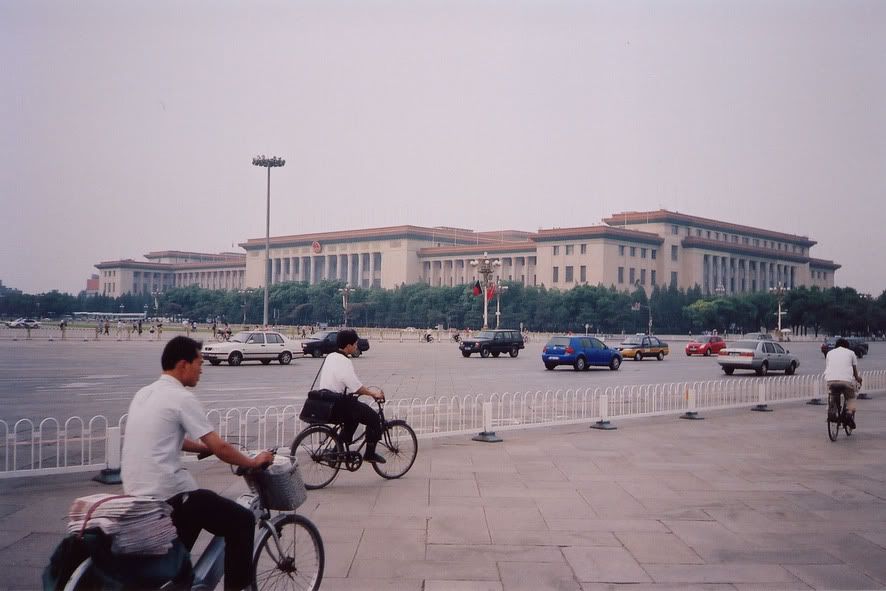

Tian'an'men Square

Today, we went to Tian'an'men Square, where the Forbidden City is located nearby. The square is indeed square in shape, and there are four important structures at the four sides of the square, one being the Forbidden City; the others include the China People's Assembly Hall, the national museum and the Mao Ze-dong Mausoleum. At the square, we enjoyed taking pictures.

Not long after that, we made our way to the Forbidden City. Only having stepped into the Forbidden City did we realise that the palace was indeed very, very big! One could easily get lost in such places. One thing that we observed was the fact that there were no trees at all in the compound of the palace. We asked our tour guide for the reason to such an observation. He replied that this had got to do with feng-shui, and his explanation was logical. However, as the explanation is long and quite complex, I don't propose to elaborate it here.

For your information, the name of the Imperial Palace still lives up till today. Certain parts of the Forbidden City, as its name suggests, still remains forbidden to tourists. For instance, we were not allowed to enter the room where the throne was located. We could only take pictures from the outside. This is to prevent tourists from damaging any part of the throne. Its historical value is so high that they can't risk tourists peering in and then causing any damage.

We walked further into the Forbidden City and eventually we reached a garden area within the palace compound. The garden is the only area where you could see greens. Some of the trees there are hundreds of years old. It's quite hard to believe but that's the fact they claim is right.
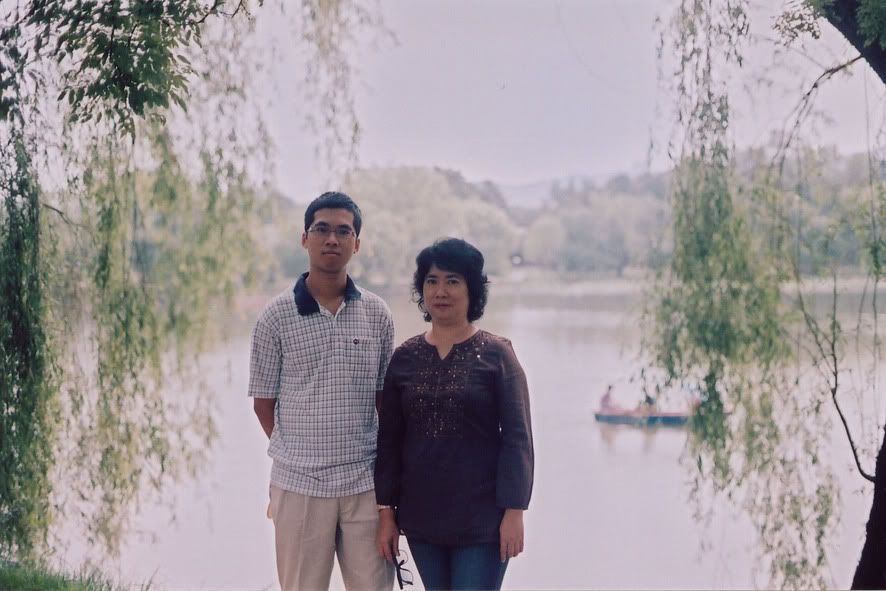
Quite a beautiful view of Summer Palace (weeping willows)
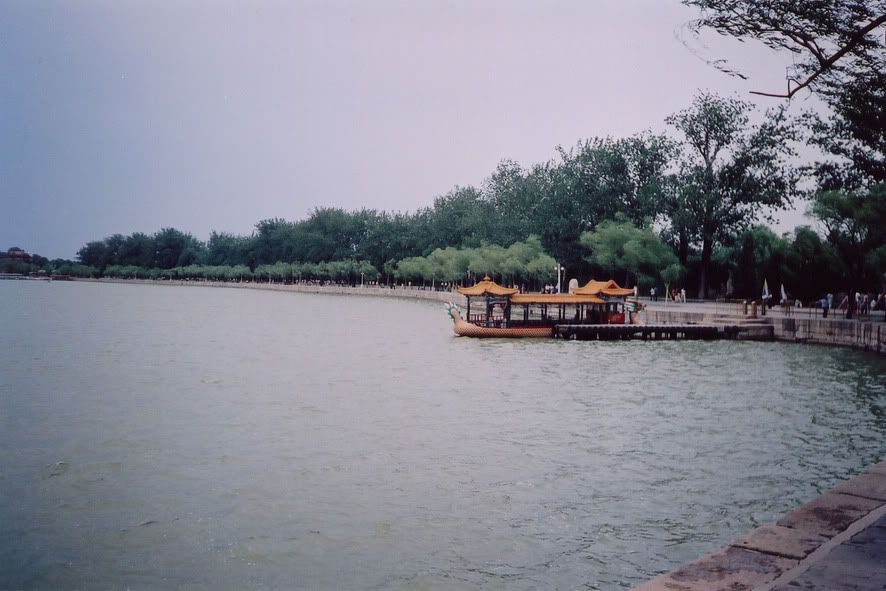
Exterior view of the Summer Palace

After lunch, we made our way to the Summer Palace. This palace was a residence where the Empress Dowager Ci'Xi used to live together with the emperor. The Empress Dowager was a very vain woman who cared not for the country but for herself. In those days, 60 copper coins would suffice one ordinary family at least half a year's of food supplies. However, the Empress Dowager spent 60 copper coins daily on her meals.

Being such a vain and cruel woman, she had ordered for the Summer Palace to be built, and it was from here that she ruled the country indirectly. Though she had no control over the country, she managed to control the emperor, thus turning him into a puppet.

3rd day (20th of June 2006)

Let's skip certain uninteresting parts. We went to the jade factory first where jade bangles, jade rings and so on are being sold. No, this is utterly uninteresting so I'll tell you the most interesting part of the trip for today.
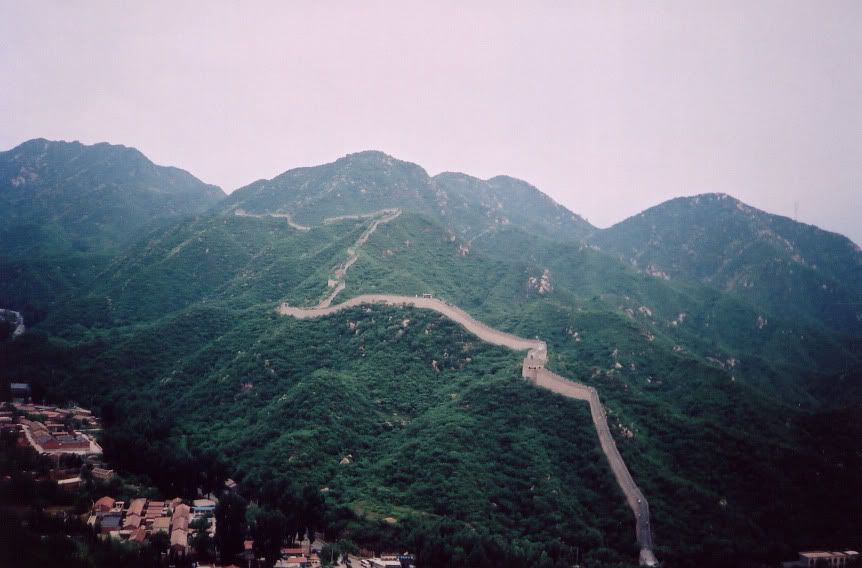
The Great Wall of China
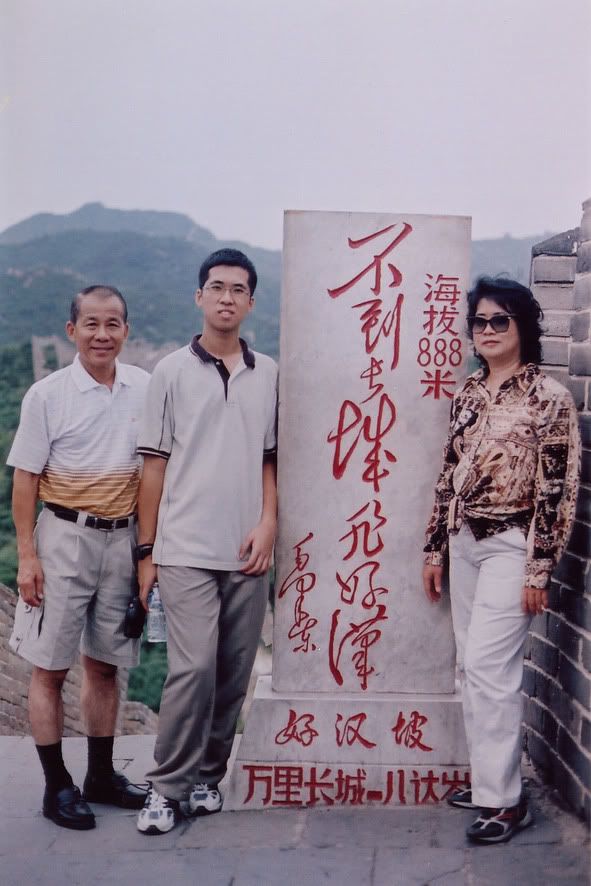
At the highest point of the Great Wall of China (888 metres above sea level; the path ahead was too dangerous for us to continue climbing)

Today, the first destination is the Great Wall of China. The Badaling Great Wall was one of the sections of the Great Wall that was chosen for us, partially because it is the best preserved part of the Great Wall of China that can be climbed. The other parts of the Great Wall is still in a deplorable condition. This is understandable because it is virtually impossible to maintain the condition of 6000 kilometres worth of stone.

There was once a claim that the Great Wall of China could be seen clearly from space. However, recently there had been debates about the ability to see the Great Wall from space. Some believe that the Great Wall is still too short to be seen from space. Well, people are still speculating.

The Great Wall was built on mountains; building the Great Wall itself already seemed impossible considering the fact that it had to be built on a very high altitude (thousands of feet above sea level), but somehow the Chinese in those days managed to complete the construction of the Great Wall of China. It was also here that I learnt something, that although the first man (or emperor) who built the Great Wall is Shih Huang Ti, yet the person who came out with the idea of building the Great Wall didn't originate from the first emperor of China. I have somehow forgotten the name of the prominent figure who first came out with the idea of building the Great Wall.

Despite being summer, it was very cool and windy at the Great Wall of China, which was anticipated, because it was built on mountains, as I had mentioned before. Upon our arrival at the Great Wall (which was about an hour's drive from Beijing), we had a group photograph and then we started climbing the Great Wall. Some of us couldn't even climb the first few steps of the Great Wall and immediately returned to the bus. My father, my mother and I persisted and continued climbing. I must admit however that climbing the Great Wall wasn't an easy feat. Some steps are about two to three feet high and some are just about one foot high. Even I, who have long legs, found it rather difficult to climb, not to mention my mother who is of course shorter than me. Some of those who climbed the Great Wall had to climb up seated, not standing. It's hard to picture until I demonstrate it to you.

If climbing up the Great Wall is difficult enough, coming down of it is even harder. My whole family managed to climb up till the highest point allowed (888 metres above sea level). Beyond that point, nobody is allowed to climb anymore, because of the damaged steps and dangerous sections of the wall.

Did I say that it was even more difficult to come down? Well, there's a simple reason to it. You see, the steps or stairs of the Great Wall are nothing like those in your house. At least the stairs back at home are built on a 45-degree inclined plane, therefore when you ascend or descend the stairs, you will not feel the steepness of the stairs. However, this is not the same for the Great Wall. When I came down the wall, I couldn't see the next step below me; it was as if the stairs were built on a 80-degree or 85-degree inclined plane. So, could you imagine it? One slip and you could fall more than thousand feet non-stop. In other words, you can't afford a small (but fatal) mistake or you'll fall to your death.

After our descent from the Great Wall of China, we made our way to lunch. Having climbed the Great Wall of China, a lot of us felt very hungry.

After lunch, we made our way to the 13 Ming Tombs. This was where 13 of the Ming emperors were buried. There were 16 Ming emperors during the Ming Dynasty, but surprisingly, only 13 emperors were buried in the one part of Beijing where the feng-shui was and is believed to be the best. The reason that there were only thirteen emperors being buried in the same area (but very far apart from each other) was that one of the emperors went missing (apparently that was why Admiral Zheng He [Cheng Ho] was summoned to find back this missing emperor, who was believed to have fled to South-East Asia). Another reason was that the first emperor of the Ming Dynasty, Zhu Yuan Zhang, was buried in Nanjing (then the capital of China). I've forgotten the reason to why the another Ming emperor was not buried in Beijing.

We were taken to the Ding Tomb. Previously in the morning, we had to climb thousands of feet on the Great Wall of China, but now we had to descend about 65 metres underground to visit the tomb of one of the Ming emperors.

Something interesting to share here. You see, before the emperor dies, the tomb was already built, and before the builders could begin their construction work, they had to drink wine until they were drunk. There is a reason for this. You see, like the Egyptian Pharaoh tombs, treasures are kept next to the coffin of the emperor, and the emperor would definitely want to prevent tomb raiders from stealing away the riches. Therefore, they had to turn the tomb builders into drunkards. These builders would then build the tomb as planned, as well as the entrance of the tomb. However, the entrance of the tomb is so well-concealed that nobody could find the entrance to the tomb at all from the outside. Even if there are tomb raiders, they couldn't break open the tomb just like that (remember that the tomb is located 65 metres underground and that the exterior part of the tomb is made of stone). The builders, who were drunk, couldn't possibly remember where the entrance was either. This served as a protection for the tomb quite effectively. Even just recently, before the Ding Tomb was opened to tourists, historians had a hard time trying to locate the entrance to the Ding Tomb. They had to drill at many sections of the tomb before they succeeded in finding the entrance.

We entered through the entrance that the historians found. Upon our entry, we found that we had to go down a flight of stairs. The depth of the tomb is comparable to a nine-storey building. We had to descend for about five minutes before reaching the tomb. There, we managed to see the place where the coffin of the emperor and his empresses (two empresses; the emperor had one at first, but she died and the emperor than re-married) was supposed to be laid. There was also a throne made of stone for the soul of the emperor to sit on.

The visit to the Ming Tombs was quite short, as there weren't much to see. What is so important about this place is that it is rich in historical value, and the scale of the construction in which the tombs were built.

4th day (21st of June 2006) [most interesting and perilous)
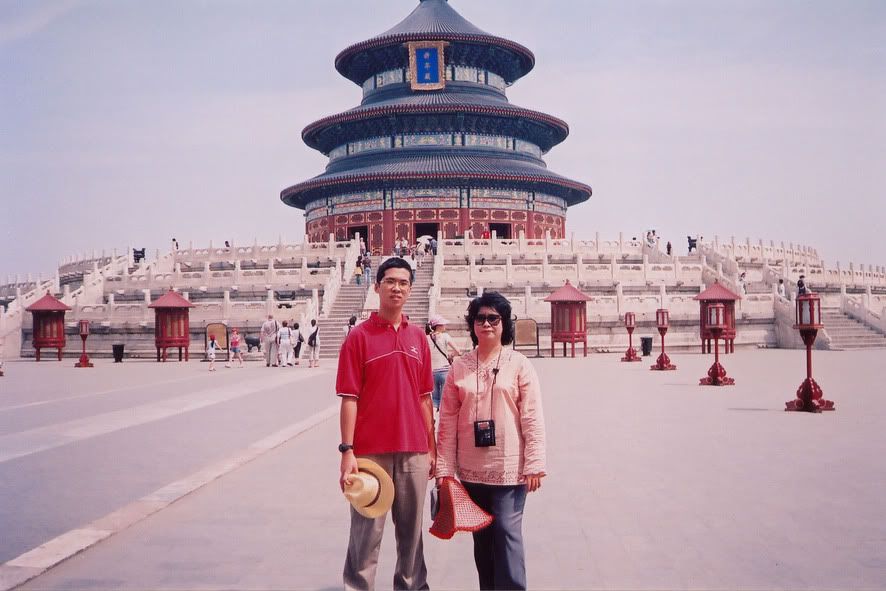
The Temple of Heaven

Before making our way to Cheng'de, we first visited the Temple of Heaven. It was where the emperors used to pray to the gods for better harvest and peace throughout the land for the following year, and to also give thanks for the tranquility and the harvest that the country had reaped all over the years.

The Temple of Heaven is cylindrical in shape, and despite being built without a single nail (not even today), about a decade or so ago, when an earthquake struck, the surrounding buildings (that were built in much later years) collapsed but the Temple of Heaven still remained intact. The stability of the temple so baffles the engineers. The foundation of the temple is so good that until today, no cracks or signs of wear and tear could be seen. However, like the Forbidden City, we could only see the interior side of the temple from the outside.

During the Cultural Revolution launched by Mao Ze-dong, this temple managed to survive from being torn down by the army. Today, after some renovation work, it is now a tourist spectacle. It was said that before China was given the honour to host the 2008 Olympic Games, the Olympic Games committee requested the Chinese government to preserve all historical monuments, among those are the Temple of Heaven, the Forbidden City, the Summer Palace and many more. Otherwise, they would refuse to let China host the 2008 Olympic Games.

From the Temple of Heaven, we made our way to another part of the temple, but before that we had to go pass a gate. There were three gates (all made of hard wood) and we were asked to choose which gate we would like to go pass. There was also a similar gate in the Forbidden City, and during the feudal era, only certain people could go pass certain gates. The centre gate in the Forbidden City could only be used by the emperor himself and his empress (once only, during her wedding; after that, she could only leave the palace through the back door). The left (west) gate was used by officials in the army (I hope I'm right) and the right (east) gate could only be entered by the other government officials, such as the prime minister and other ministers. Such protocol was also closely connected to feng-shui.

In the Temple of Heaven, there was a bit of difference. The emperor was not allowed to use the centre gate. Why? That was because the Emperor of the Heavens was said to be greater than the emperor of China, for it is the Emperor of the Heavens who provide peace and good yield to the country. The emperor of China was then thought to be the son of the Emperor of the Heavens. In other words, in those days, the people regarded the emperor of China as the descendants of the heavens. As such, only the Emperor of the Heavens (imaginary) could use the centre gate, the emperor would use the west gate.

From the gates, we made our way to another section of the temple, where the emperor would make proclamations for the country. Here, the emperor would also make offerings and burn joss sticks. This section of the temple is white in colour and was built like a stage without a roof. It was made of stone but some part of it felt like marble. At the centre of this stage is what looked like a spherical orb, where people now frequently go and stand on the orb and make wishes (but only ONE wish). It was thought that whatever wish would come true (although I had yet to find out).

Some of us who stood on the orb made a surprising discovery. Nearby was the Wall of Echoes (despite being called a wall, it's actually an enclosed building), which is said that any sound made in there would produce echoes. The Wall of Echoes was quite a distance from where we stood at the orb. However, when we clapped our hands, we could clearly hear the echo of our clapping. Bear in mind that there are no tall walls surrounding the orb and nothing to reflect sound waves. The echo was faint but clearly audible.

From the Temple of Heaven, we went for lunch and did some shopping in two flea markets. It was in one of the flea markets where I managed to buy something I was interested at: a traditional Chinese outfit. I bought only the long-sleeved shirt, but not the pants. It fits me just nicely and it costs only RM40 (or 80 Chinese Yuan). You can't get that made here in Malaysia at that price. Plus, the shirt has a double-layer, which is normally found in blazers and executive coats.

After some shopping, we made our way to Cheng'de. What was to be a four-hour journey became a six-hour one. In the middle of our destination, we met in an accident. Our bus driver was no speed fiend, and he was within the speed limit. About 100 metres in front of him, he saw an old man (topless) wheeling his bicycle and was crossing the road. At 60 km/h, the bus could not stop in time to let the walking cyclist pass so the driver sounded the horn. Surprisingly, that old man looked right instead of left (we were approaching from his left), and continued crossing, totally unaware of what was going to hit him!

The driver didn't stop sounding the horn and frantically stepped on his brakes, trying his very best to avoid hitting that old man. I, who was sitting in the centre seat at the back of the bus could see clearly what was happening; when the driver applied his emergency brakes, some of the passengers screamed while others (including me) simply shouted, "Whoa!" or "No!"

After that, we heard, "Crash!" followed by "Boom! Boom!" before the bus came to a complete halt. I realised that the first "Crash!" was due to the collision of the front wheel of the bus with the road divider. I couldn't and still can't tell for sure what the "Boom! Boom!" was. In my heart, I was praying that we didn't knock down that careless old man. In an instant, the driver, the local tour-guide and our tour leader got down of the bus and rushed behind to check out the condition of the old man. He was unhurt (we didn't knock him at all, thanks to the skill of the driver) and totally drunk (they reported that the old man's breath had a strong alcohol smell). In his bicycle basket was another bottle of beer. Tailing behind us were two buses who were also on the way to Cheng'de. They witnessed the accident and the drivers of the two other buses came down to see what happened and to offer assistance.

Upon seeing that the old man was unhurt, we heaved a sigh of relieved and began talking about the accident. However, this was only the beginning of our delay. To our horror, while trying to avoid the old man, the rear left wheel of the bus collided hard with the road divider and burst, thus causing the tyre to go flat. The driver brought the bus to the side of the road and stopped. The other two buses who followed us from behind also stopped behind us. The drivers and the other local tour-guides came down to see what happened and found the flat tyre.

There were seventeen of us in our tour. The two other buses were also actually fetching Malaysian tourists from Beijing to Cheng'de. One of them actually would have liked to offer our tour a lift to Cheng'de to save time (while the tyre of our bus got replaced), but unfortunately being such a small bus, there was no room at all. The other tour group in another bigger bus could still accommodate another ten of us, but that particular group itself refused to offer help. The tour-guide could do nothing but to comply with her customers' request and left after apologising to us that she could do nothing to change the minds of that particular group. We were rather angry with them for being so heartless and pitiless. The group who regretted not being able to offer any assistance at all to fetch us to Cheng'de asked their driver to help us replace the flat tyre.

It was most unfortunate that the spare tyre itself was semi-flat, but our most fortunate part was that there was a tyre shop exactly opposite to the place where we stopped. In no time, a tyre was requested from that shop and in about twenty minutes they managed to get the flat tyre out and the new tyre in.

After all that commotion, we were ready once again to leave. The group who stayed put to make sure that we could continue our journey asked our driver to be in front of them so that they could still offer help if the needed arose. Fortunately, the need never came and it was around 2130 hours before we finally saw the lights that adorn the city of Cheng'de (we started our journey at about 1500 hours). We were indeed grateful to the group who actually were so willing to sacrifice their time to help us and see to our needs during such critical moments. We were also happy that our driver managed to avoid knocking the old man with such skill. It would have definitely been fatal for that old man if our driver were to knock him down.

5th day (22nd of June 2006) [the aftermath of the accident]

Although all of us had a good sleep the night before, the aftermath of the accident which happened in the middle of our journey to Cheng'de was still felt. Most of us were still talking about the accident and about the consequences if the bus had collided with the old man.
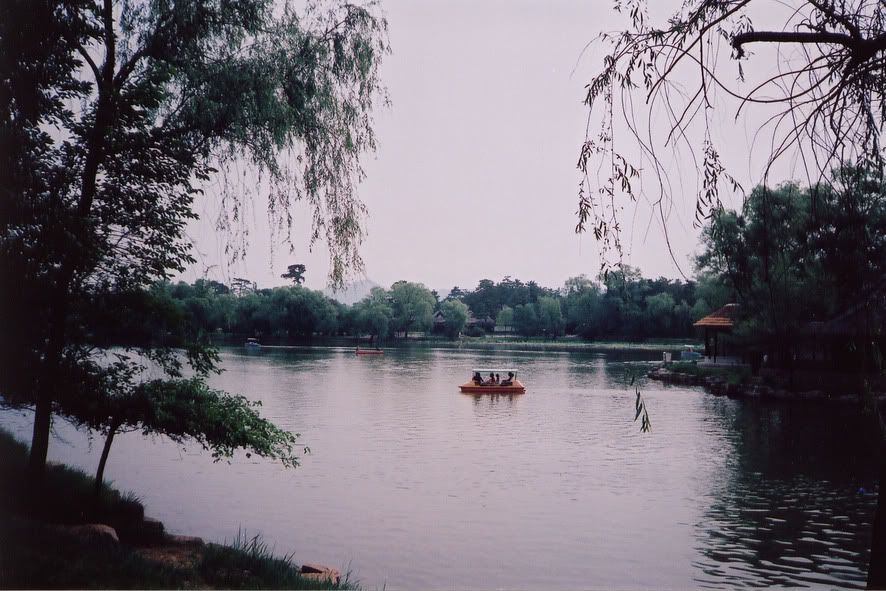
Another scenic view at the Summer Resort

Nevertheless, we were all ready for our tour. There, we had got another tour-guide who lives in Cheng'de. She is also a Manchurian and we were first brought to the Summer Resort. The Summer Resort is another palace built by the emperor during the Qing Dynasty for the emperor to do his hunting and for the army to train. The emperor would spend eight days from Beijing to Cheng'de and stay in the Summer Resort during the second half of the year. Here, various animals could be seen and hunted, among them the deer, wild chickens and so on.

The Summer Resort itself occupies half of Cheng'de and is (if I'm not wrong) sixteen times bigger than the Summer Palace in Beijing. Therefore, it would not be practical for us to walk the whole of Summer Resort. We had decided to take the buggy then. Even travelling around Summer Resort in the buggy took us about three hours to complete our tour there. Within the compound of the Summer Resort, there is a five-star hotel. To me, I would rather call it a chalet because the rooms are built like chalets. Instead of bricks and concrete, the rooms are actually constructed using plastic with steel frames, more like those Mongolian camps that you could see in Mongolia.

The Summer Resort was like the second home for the emperor. During the emperor's stay here, most of the governing was also carried out in the Summer Resort. Emperor Kang'xi and Emperor Qian'long were among the Qing emperors who stayed in Summer Resort during the second half of the year.

There is also a range of walls surrounding the compound of the Summer Resort. These walls were also built on the mountains and people often thought that they are the continuation of the Great Wall of China. In fact, these walls did not originate from the Great Wall of China, although one section of the Great Wall does pass by Cheng'de.
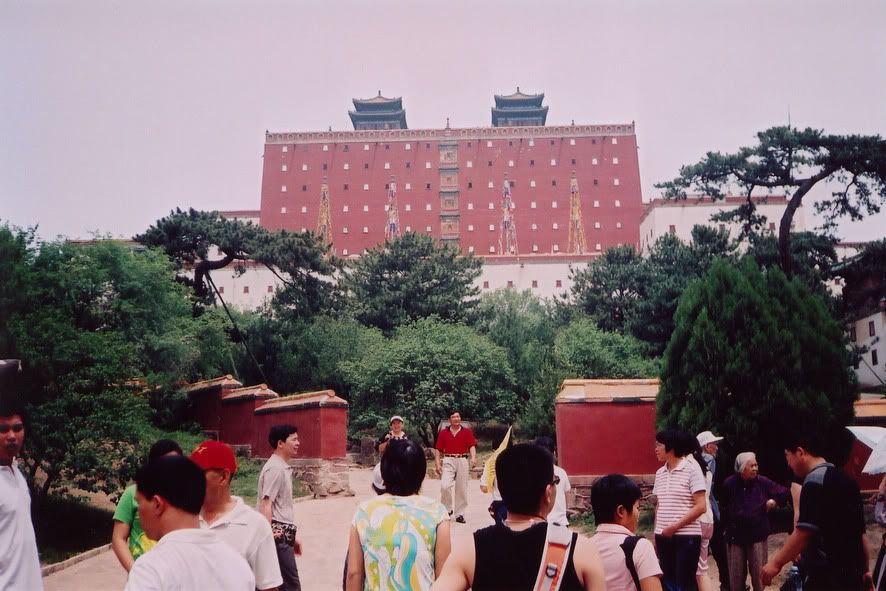
Pu'ta'la Temple

After visiting the Summer Resort, we made our way to a Lama temple known as Pu'ta'la Temple. The design of this temple is similar to the one in Tibet and was blessed by the Dalai Lama. Today, it has become a tourist attraction. What is so special about this temple is the fact that the design itself is different from the other temples. The temple is rectangular and with windows that are sealed with bricks (they are never open). Often, when the building is painted in red, the windows are white and when the building is white, the windows are red.

The temple itself is located on a hill, and is about 80 to 100 metres tall. It is a giant structure by itself. Within the temple is a pagoda with roofs covered with tiles plated with gold. During the Second World War, the Japanese soldiers (it seemed) raided the temple and saw the gold-plated tiles of the roofs on the pagoda. As one of the roofs was particular low, the soldiers could scrape off the gold from the tiles, leaving the copper beneath it. The gold-plated tiles where the soldiers could not reach were left untouched.

It was also here in Pu'ta'la Temple where my mother bought home two bags of sweet snacks. I don't know what they are called in English, but they are covered with sesame seeds. After hearing the name of the snack in Mandarin, our tour leader immediately made fun of the name in front of the others (you wouldn't want to know; it's not something really good). We all laughed so much.

Our stay in Cheng'de lasted for only a day and a night. After lunch, we bid farewell to our tour-guide and made our way back to Beijing. Here, I must note that although Cheng'de is one of the smallest cities in China (even smaller than Ipoh), its progress is comparable to that of Kuala Lumpur, with skyscrapers towering here and there.

We arrived Beijing again in the evening at around 1800 hours. We had our dinner and immediately made our way to the Hot Springs Resort in the outskirts of Beijing. It is a five-star hotel with a public bath located adjacent to the hotel and also a private bath which can be found in every hotel room. Being curious about bathing in the hot springs, naturally I decided to join some of the tour members (my parents decided not to participate) who also wanted to have a bath in the public bathing area.

So, with my swimming trunks in hand and a swimming cap (I had to buy one there! Rules are rules, it seemed), we made our way to the public bath. Here, I used the word "public" as in "confined to hotel customers only". There is a swimming pool (which is really cold!) and about six to seven hot baths; each bath has its own medicinal value. Every hot bathing pool is not just merely hot water at 40 to 45 degrees Celsius; each of the pool contains certain herbs that supposedly play a certain role in our health. One of the pools has rose petals covering the surface, another contains milk (good for the skin)!

The bathing area is very well-maintained. There are strict rules and regulations on how one should use the baths and the swimming pool. For instance, it is compulsory to wear a swimming cap in the swimming pool and you are not allowed to walk around the bathing area without your slippers, which are provided at the lockers. Also, you are only permitted to stay in every hot bath for a maximum of fifteen minutes, in which after that you are required to have a five-minute break away from the pool. Only then are you allowed to enter another pool for another hot bath.

Besides taking a hot bath and a good swim, I also had the opportunity to use the Jacuzzi and the sauna. Well, travelling after all meant enjoying yourself, right? Therefore, I was just merely trying to enjoy myself to the fullest.

We spent about an hour and a half there in the public bath. We would have stayed there longer had it not been due to the fact that we had to wake up early (about 0630 hours) the next day.

6th day (23rd of June 2006)

Today, we had to check out from the five-star hotel. It was only a one-night trip, yet, a most memorable one ever! Five-star hotels always come with a five-star service by the hotel staff.
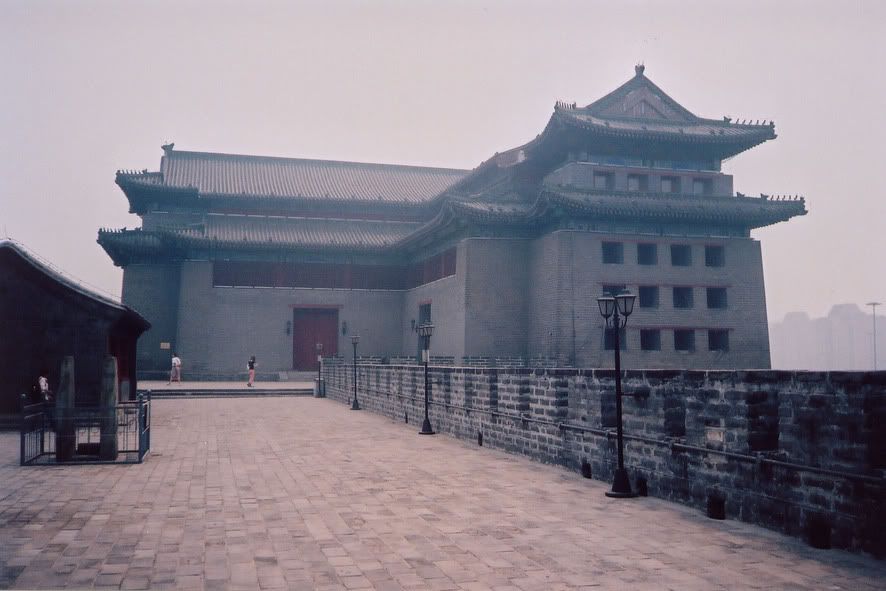
The fort of the Beijing North-east City Gate

Anyway, enough about that hotel. Today, our travels took us to the Beijing North-east City Gate. Upon our arrival at the gate, there was nothing special at first glance. However, little did we know that we were on luck, for the City Gate is open to tourists on certain days only. Feng-shui masters have said that the city gate should only be opened for 108 days in a year, and those 108 days are chosen at random, based on feng-shui.

The Beijing North-east City Gate looks similar to the Great Wall of China, except that it is not part of the Great Wall. Its main function during the feudal era was as a defence system against the enemies. This gate was also the main entrance to the city of Beijing in those days. As the city gate is well-kept and preserved, much of its history can still be seen. Like the Great Wall of China, it was hard to believe how the ancient Chinese managed to build such a gigantic structure when cranes and pulleys were not invented!
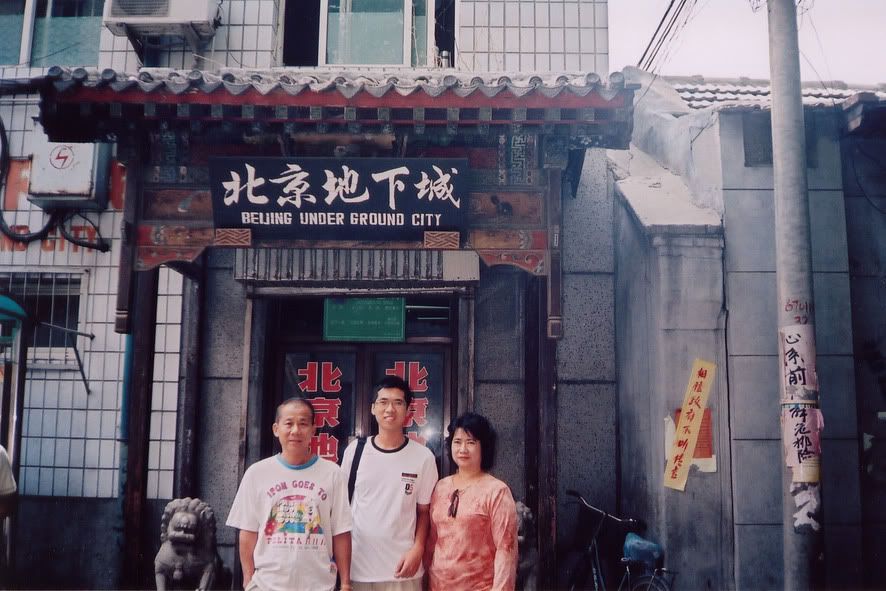
Main entrance of the Beijing Underground City
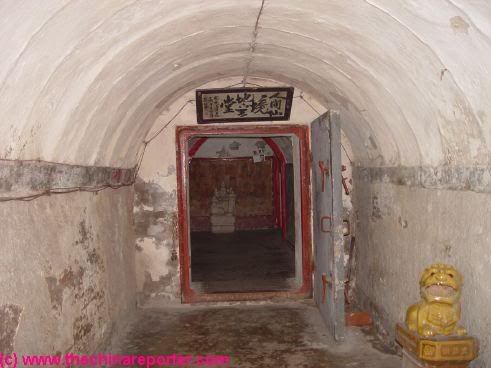
The interior view of the Beijing Underground City (courtesy of The China Reporter)

Next, we went to the Beijing Underground City after lunch. It is also known as the Underground Great Wall of China, for an appropriate reason. During the reign of Mao Ze-dong, he foresaw that if there was war in Beijing, there would be a lot of bloodshed and destruction; rebuilding the city would take ages and it would take even longer if there was a sudden downfall in the population of Beijing. Therefore, Mao had instructed that an underground city be built. This was a secret tactic used in preparation for any war.

Under the orders of Mao, the digging began. It took ten years for the Underground City to be completed. If there is a hospital above ground, then there will also be one underground. If there is a school above ground, then there will be one underground, too. Whatever existed above ground would also exist underground then, except for cars.

Now, the reason that the Underground City is also known as the Underground Great Wall of China is this: the Underground City in Beijing is connected to all nearby cities. In fact, you can walk inside the Underground City and arrive at Tianjin, Shanghai, the Temple of Heaven, Tian'an'men Square, the Great Wall of China, literally speaking, almost anywhere! The length of the Underground City is comparable to that of the Great Wall of China.

The Underground City served its main purpose as a defence system. During emergency periods, the army fought from within the Underground City. There was a room in the Underground City where ammunition was kept and there was also a room where orders were given to the rest of the army to prepare themselves for battle.

The Underground City remained hidden until recently when it is opened to tourists (selected ones only). The Underground City is very damp and wet. During the 1960s, the people who lived in the Underground City faced a critical problem. Due to the damp and wet conditions of the Underground City, people suffered easily from rheumatism and arthritis. Mao Ze-dong realised that this was serious and therefore ordered the problem to be solved. An ingenious solution came. It was found that silk blankets and silk clothes were able to counter the effects of rheumatism and arthritis. They could also prevent rheumatism and arthritis from showing up in the first place. Immediately, a silk factory was built underground. However, as there were a lot of people in Beijing, the demand for silk blankets out-numbered the supply. Therefore, only those with chronic rheumatism and arthritis were privileged to use the silk blankets. (Note: Silk blankets help absorb moisture but does not give out a foul smell, unlike cotton.)

As the Underground City is still regarded as an army area, no photographs were allowed to be taken. The picture that shows the Underground City was taken by another person secretly and uploaded into the Internet. In the Underground City, there was another tour-guide who was in charge of taking us around there. He explained that a lot of the staff who still work in the Underground City are either volunteers or trainee soldiers for the Chinese army.

The tour in the Underground City took two hours, so you can imagine how long and big the Underground City is. During the period of two hours, I noted that the Underground City was surprisingly cold, but no air-conditioning units were found! Throughout our journey underground, only the silk factory remained warm and cozy.

Although the Underground City is now a tourist attraction, unfortunately, the Chinese government has decided to tear it down for development above ground. In about a month, the silk factory in the Underground City will close and the Underground City in Beijing will be demolished. It is a pity that such a historical place has to be removed for the sake of development.

7th Day (24th of June 2006)

After breakfast, it was off to Tianjin. The trip took us about three hours. During the trip, fortunately, there was no mishaps.

Tianjin is a described as "10-years-ago Beijing". In fact, the people here live as if they are still in the 1990s. The city still look 1990s but nevertheless a developed one.
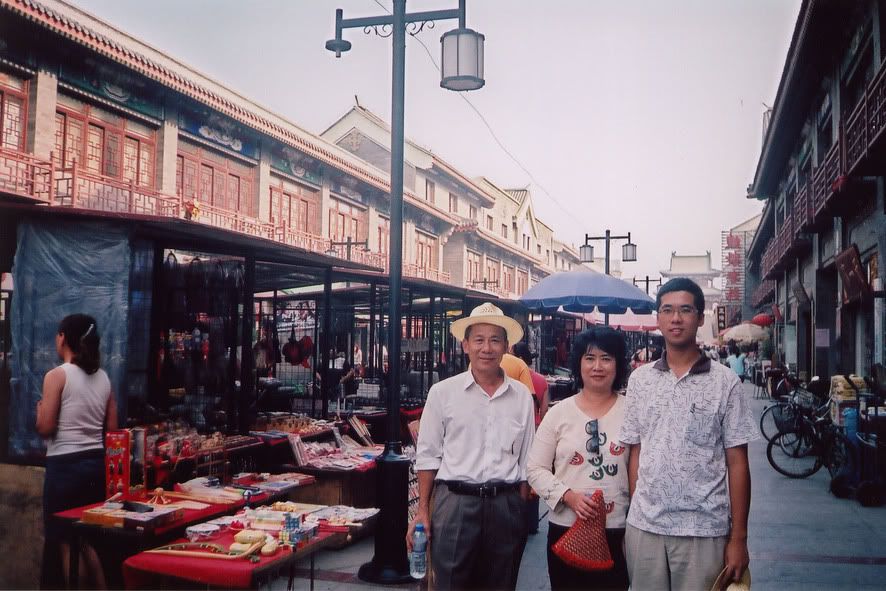
Tianjin Cultural Street (perhaps this is the most beautiful picture of all)

Upon our arrival in Tianjin, we found that there was nothing really special about Tianjin, except for its two streets, Cultural Street and Food Street. The former strongly suggests that the street is one where all cultural works can be found. In fact, it is! From visual arts to embroidery and music, all can be found here in Cultural Street! There are shops selling Chinese paintings, Chinese instruments, embroidery, calligraphy materials and so on.

Here, we took a picture (as seen above) and unknowingly, that is one of the best shots taken during our trip. That is a view of Cultural Street. As you can see, the shops and stalls there look 1950s and 1960s. To us, it was as if walking in history (my father's straw hat made the whole scenario even more 1960s!).

It was also here in Tianjin where we had our dinner before returning to Beijing. After dinner, we were met with another disaster. The bus somehow, during the journey to Tianjin, had its wheel pricked by a nail and was becoming flat. The bus driver assured us that he could still fetch us back to Beijing, but could not make it to our hotel; it would be totally flat by then. Being such a considerate driver, he drove slowly during the whole journey, which caused our return trip to be about four hours. Before entering Beijing, he stopped at a rest house where another bus, he said, was waiting for us. Apparently, he had arranged for another bus to take us back to our hotel while he would stay there to settle the flat tyre issue. He would not be fetching us back to the airport the following day. So, there we bid farewell to him.

As we had no luggage to shift, it made things much easier. We had to just transfer some of our personal belongings that we brought along (such as cameras and the like) to the other bus. Soon, without much talking, we headed back to our hotel in Beijing.

Upon our arrival at the hotel, nobody spoke much either. We were too exhausted to say anything at all. All that we could think of was "glorious bed".

8th Day (25th of June 2006)

This is the day which marks the end of my Beijing-Chengde-Tianjin trip. However, as our flight was in the evening, we still had some time in the morning so off we went to the Panda Zoo.

At the Panda Zoo, we were hoping to see a lot of pandas. We did, but we couldn't see much. Why, you ask? Because pandas are such shy animals! We were hoping to be able to see their front view, however, much to our annoyance, they kept facing their backs at us, munching at the bamboo leaves happily. Still, at times we managed to see their front view. Unlike bears, pandas have paws that work as hands, which allow them to grasp bamboo and climb trees. They have joints at their paws which allow them to function as hands.

The panda has now become the mascot of the 2008 Beijing Olympic Games. Many still do not understand the reason to why the panda is chosen as the mascot. Many thought that the panda is a lazy animal. However, it was said that the panda was chosen as it represents tranquility (peace). From the behaviour of the pandas, they certainly look peaceful and carefree.

After lunch, it was time to go to the Beijing Airport. By now, we were indeed longing for home, but personally I was not longing for the same aeroplane! I was hoping for a Boeing 777, but somehow deep inside me, I knew that it was going to be an Airbus A-330 again.

At 1630 hours, we boarded the aeroplane and were perfectly ready to take off when the pilot had some bad news for us. The weather outside was terrible and visibility was less than 2 kilometres. In fact, I could hardly see anything 50 metres away from the window! Therefore, our flight was delayed. There was a Singapore Airlines plane which was delayed, too, and they had been delayed for the past an hour!

We waited and waited for the permission from the control tower for us to take off. It wasn't until 40 minutes later whereby we were informed that we had to queue to take off and we were the 22nd or 23rd in the line. Everybody was groaning and complaining about the delay.

We had to wait for another one hour (the plane had to even re-fuel!) before the pilot said that we were the next plane to be permitted to leave. And in a few minutes, the plane started to move. All the passengers heaved a sigh of relief and were happy that they were at last going to take off, but not my father. The delay was a disaster to him! He had bought three tickets for us to return to Ipoh. The return time of the bus from KLIA to Ipoh was 0030 hours on 26th of June 2006. We took off at around 1800 hours and it would take at least six hours to arrive at KLIA. It was impossible to be able to catch the bus!

Anyway, the flight took six and a half hours! We just calmly got off the plane, had our passports verified, claimed our baggage and went to see if the bus was still there (we weren't hopeful). As expected, the bus was gone. However, the good news was that our tickets were good for the next bus as well, meaning to say if we missed the first bus that we were scheduled to be in, we could take the next bus home, too. But, the next bus will not come until 1000 hours. So, we had about nine hours to spend!

As getting a hotel would be totally a waste of money, we decided to spend the night in the airport. Although it was uncomfortable, we had to catch some sleep. At 0700 hours, we woke up and had our breakfast at KFC (porridge and chicken) and waited for the bus until 0930 hours. The bus had come earlier than it was expected, and at 1000 hours sharp, we left KLIA for Ipoh.

Three hours later, we arrived Ipoh safe and sound. It wasn't until we arrived home finally that we simply forget about unpacking and had a good day's sleep.

That concludes my Beijing travels. I hope you have enjoyed it.

Labels:

Sunday, August 06, 2006

A visit to the alma mater

My visit today to my alma mater was scheduled at 5.30 p.m. but after having lunch with Liew Kei Fai, who is having is one-week break from MMU, we decided to go to school much sooner.

We wanted to see how our friends who are involved in the drama are doing. In fact, they were having a full-dress rehearsal last night. I wanted to go to school to give away my piano stool. I have two of them, one adjustable and a non-adjustable stools. After getting myself an upright grand piano, the non-adjustable stool was of no use because it was too low. Therefore, I've decided to give it away to the school because the piano in the school hall lacks a stool (the original stool that they had was damaged and disposed off).

Upon our arrival at our alma mater, the first thing that caught our eyes was the cleanliness of our school. Doubtless, we cannot expect to have a second Mr. Louis, who had been so dedicated to the school that he even used to pick up the rubbish and throw them into the dustbin. Nevertheless, being a school, I trust that the students would be well-educated enough to know what a dustbin is for, right? We couldn't believe it to see so many kacang putih wrappers, plastic bags, soft-drink cans and tissue papers all over the floor and the field! Have the words "cleanliness" and "civic-mindedness" simply left from the vocabulary of the students? We shook our head in disappointment.

Still, we continued to take our journey down memory lane. We went to the construction site where the new primary school building is being built. My, we opened our mouths in awe! The design of the new primary school building is exactly the same as the U. Paul Block, which is the British-Colonel style! We could hardly believe that there are still people who are willing to construct such a work of architecture! The engineers who are in this project are brilliant enough to make full use of the space they have! From what I have observed, they have utilised the space at the corner of the primary school field (which many don't do) which gave them extra floor space! It was a magnificent spectacle from the canteen, although the building is not completed yet. I don't care; I'm going to get my son into St. Michael's next time (IF I will have a son, that is).

After Kei Fai left SMI, I made my way to the artroom, where all the actors of the drama were putting on their make-up. All this made me recall the times when I was involved in Flower Drum Song (2002) and The King And I (2004). I had so frequently teased those who put on their thick make-up and yesterday was no exception either. One Form 1 boy (who is playing as Clopin's puppet) had such a cute make-up (he is very cute without a make-up too) that everybody, boys and girls included, wanted to play with him. Some even teased him (teachers included)! We all laughed.

After fooling around with the musicians and demonstrated my own playing of some of the drama songs, I stayed for another while to have a chat with some of my friends. Overall, I had a good time there, and for the first time ever, I felt so welcomed among the drama team although I am not one of the participants (much to be regretted, because I'm currently in UTP). I had never been treated like that during the years when I was not in the drama team.

I left at around 6.30 p.m.

Today, when I wanted to continue with my Beijing Trip entry, I was surprised to find that all the audio files which I have uploaded into Uploading It have vanished! Well, looks like there will be no audio files to be played in that entry. Pictures and text are what you will all see.

My Tagboard has been temporarily disabled because there is a lot of spam; they advertise websites that take you to gambling sites. I shall put up a Chatbox (no more from Tagboard) later.

Labels:

Friday, August 04, 2006

Orbituary

Lee Khian Yip
(1988 - 2006)


Sincere condolences to

Lee Wan Yee and her family

for the demise of Lee Khian Yip.

May his soul rest in eternal peace.

Requiescant in Pace.

Lee Khian Yip, in his last moments, had managed to contact his father to inform the latter about what had happened to him. He was hacked to death while returning to his hostel in Wangsa Maju. He had passed away due to severe loss of blood.

The incident happened at around 9.00 p.m. on the 29th of July 2006.

No more blogging for the next day.


Labels: